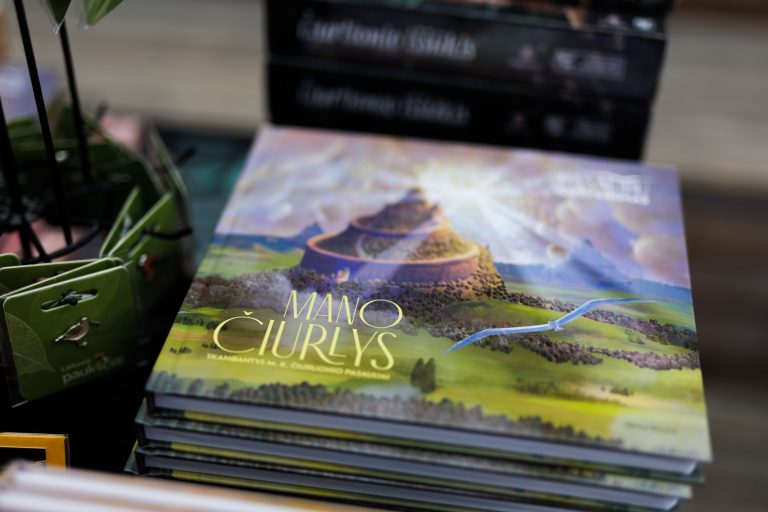
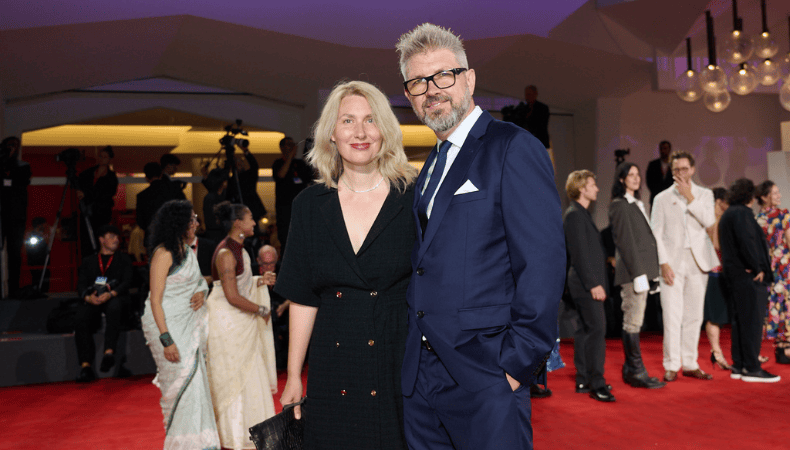
After returning in September from the Venice Film Festival — where the world premiere of the virtual reality experience Creation of the Worlds took place in the Venice Immersive program — directors Kristina Buožytė and Vitalijus Žukas share their impressions and behind-the-scenes insights.
They reflect on the journey from the very first ideas to a fully immersive experience, on interpreting the universe of Mikalojus Konstantinas Čiurlionis through the VR medium, and on what it means to present a Lithuanian work on one of the most important stages of world cinema — in this interview.
– When did you realize that after Trail of Angels you wanted to return to Čiurlionis — this time with a completely different VR experience?
Vitalijus: It didn’t happen right away. We also considered other artists, but over time Čiurlionis’ pull became irresistibly strong. We realized that the story he tells is not yet finished, and that we wanted to return to the world he created — to bring back new stories from it. And even today, after two works, we still feel the same way.
Kristina: We kept receiving the same question from audiences: when will there be a next part? At first, I was rather skeptical. However, hearing that question again and again, and realizing just how vast Čiurlionis’ body of work is — and that with Trail of Angels we had only touched a small fragment of it — my view on creating a new piece began to change.
Čiurlionis’ world is immense. He is an exceptionally interesting and profound artist, whose ideas and messages have not lost their relevance even today, and we felt a strong desire to convey that depth to the audience as well.
– What was the initial creative hypothesis: what can VR say about Čiurlionis’ worlds that a cinema hall or a gallery cannot?
Vitalijus: If you are able to look and truly feel, you can see everything even in a gallery. But there comes a desire to share what you have seen — and this is where virtual reality offers limitless possibilities. It is a medium capable of transporting you into a real yet wondrous world, where everyday life fades away and you enter a parallel universe.
Kristina: Čiurlionis’ works are ideal for the virtual reality platform — this is where they reveal themselves most fully. It feels as though he lived within his own creative universe, where images, music, and ideas were woven into a single, harmonious whole. The VR platform allows us to glimpse his world and feel the emotions it radiates.
– Creation of the Worlds encompasses the cycle of creation, flourishing, destruction, and rebirth. How did you dramaturgically structure this rhythm — this breathing — within the VR space?
Vitalijus: There was no need for heavy structuring — Čiurlionis had already done it all. Our task was simply to see it and translate it. All the narratives are embedded in his work; it was enough to connect a few points. The process was made easier by the fact that he himself drew on a biblical narrative.
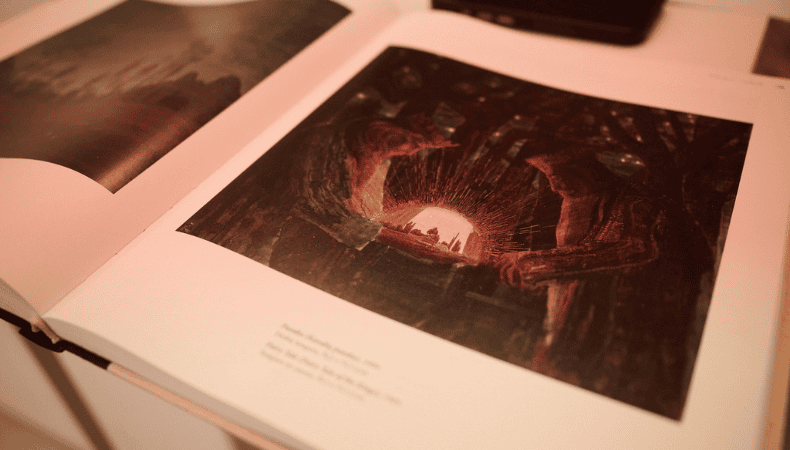
But this is not the Bible as we usually know it — it is a book of parallel universes, with both similarities and differences. Look at the Creation of the World cycle: the flora and fauna resemble our world, yet they are not copies of it — there are two moons in the sky… We also allowed ourselves to imagine further. For example, in our story the flood is caused not by God, but by a demon — for us, this felt more relatable.
Kristina: It is also a story about human maturity — we arrive in a created world in order to experience it, and as we live, we eventually realize that we ourselves are the creators and guardians of our own worlds. All these narratives already exist within Čiurlionis’ paintings; our role is to see them and convey them to the viewer.
– How does your second VR work differ from the first one — in terms of goals, narrative, interactivity, and technical scale?
Vitalijus: It differs in many ways, and this was a conscious decision. Creating a continuation of a successful work is difficult — there is a temptation to repeat the winning formula, simply elevating it to a higher technical level. We chose instead to search for new forms of storytelling, new emotions, and new sensations.
The spirit of Čiurlionis remains, but there are far more differences between the works than similarities. Trail of Angels was a sacred experience — many people cried at the end, experiencing an emotional catharsis. Creation of the Worlds is more of a transcendent tale, immersing the viewer in a meditative state where the viewer and the world merge into one.
It is an experience of free flight, reminiscent of dreams. In the PC version, this flight is controlled by the viewer — there is no need to learn any mechanics; it is enough to believe that you can fly.
Vitalijus: Technically, everything has grown to a much larger scale. For example, the Muona team spent several months creating the city — studying all the elements of Čiurlionis’ Cities cycle, building their models, and assembling a coherent, logical urban environment.
In the PC version, the viewer chooses their own flight path and can even discover hidden routes. One could write a separate article about all the differences, but what matters most to us is that the majority of viewers say they truly enjoy both works.
Kristina: I’d also like to highlight the music — this time, instead of using existing compositions, we worked with Rokas Zubovas and Phil Von, who created an original score specifically for this experience. They drew on motifs from Čiurlionis’ existing works, which Rokas expanded through his improvisations, while Phil brought everything together with an electronic music soundscape. It was a very engaging and inspiring process.

– What creative decision did you not allow yourselves in Trail of Angels, but which the maturity of VR and technology made possible in Creation of the Worlds?
Vitalijus: It wasn’t so much new technology that gave us more possibilities, but rather the fact that we had more time and a larger team of specialists. This allowed us to expand the scale of the project and discover new technical solutions.
– Music and sound — where did you begin: with the visuals or with sound dramaturgy? How did the collaboration with the composers unfold, and how does Čiurlionis sound within the VR medium?
Vitalijus: We began with visual dramaturgy, but very quickly the music started to influence the image as well. It became a kind of ping-pong between sound and visuals.
In Trail of Angels, we used Čiurlionis’ music together with a minimalist composition by Mindaugas Urbaitis, which added a sense of modernity. Creation of the Worlds required a new path. We found it after hearing a concert by Rokas Zubovas and French electronic music artist Phil Von, interpreting Čiurlionis’ music. That experience deeply impressed us and opened up a clear creative direction.
I am completely satisfied with this decision — for example, the scene with the three suns would not be nearly as powerful without the hypnotic, almost ecstatic effect of the music.
– The curators of the Venice Immersive program described your work as visually powerful and meditative. What does meditation mean to you in VR art?
Vitalijus: It is the cornerstone of our creative work. VR is a powerful medium capable of conveying a wide range of emotions — from empathy to existential fear. What interests us most is its ability to stop time, to make the viewer stay within a moment, to feel the world as something new and full of wonder, much like in childhood. This is important to us personally, and we believe it is no less important for the world as a whole.
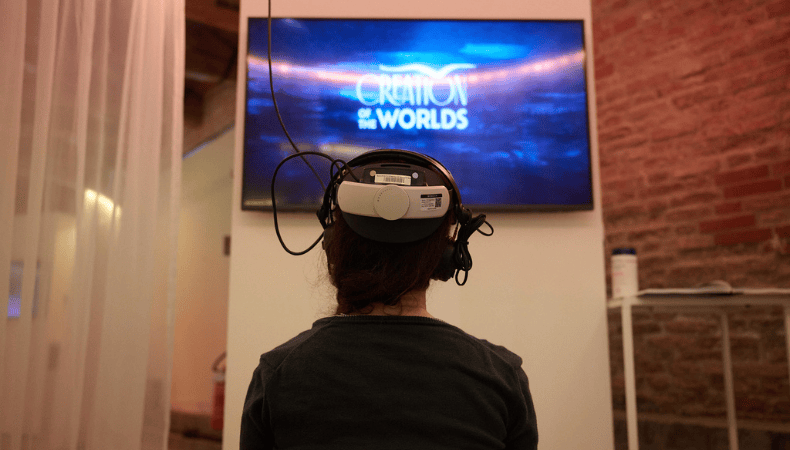
– Which response in Venice surprised or moved you the most?
Vitalijus: What moved me most was learning that some viewers were long-time fans of Trail of Angels and had been eagerly waiting for our new work. Many wanted to experience it again, though the festival system hardly allows repeat viewings.
What was most surprising, however, was hearing the curators themselves admit that they watched Creation of the Worlds many times — after intense days of festival preparations, it helped them release psychological tension.
Kristina: Yes, exactly. When Lisa Rosenthal, curator of the Immersive program, told us that after long workdays she would go to watch our piece in order to rest and recover, it was truly moving to hear. We spent a great deal of time with Čiurlionis’ works, and we are often asked whether we ever grow tired of them — but there is so much light in his art. It both recharges and inspires us.
– What is your decision-making ritual as a creative duo?
Vitalijus: It’s a simple rule — the decision goes to the one for whom it matters more. If it’s not that important to one of us, they step back. If we’re unsure, we say: let’s try it — if it doesn’t work, we’ll change it. In truth, disagreements are rare. Our duo likely formed because we share a similar artistic taste and value system. Often, while watching a new version, I would hear Kristina voice the exact comments I was just about to make myself.
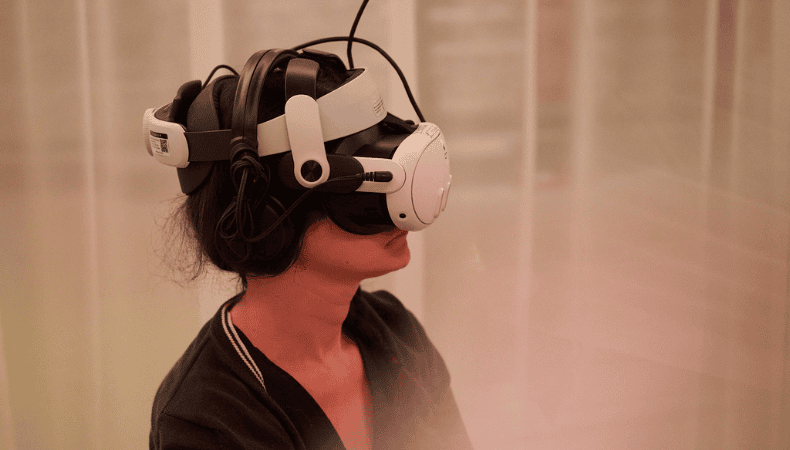
– If you had another six months for creation, what would you add?
Vitalijus: The work has already been born, and we want to let it go on its journey. Perhaps I would only adjust a few visual details that I’m not entirely happy with. We are already working on haptics — wind and scent elements.
Kristina: Yes, the work is already finished and completed at the stage we intended. It will be very interesting to hear audience feedback once we enhance the experience with multisensory elements — wind, scents, and haptics. This will allow us to blur the boundary between reality and the created world even further.
– Which VR / XR direction do you consider still underexplored in Lithuania, and what would you like to experiment with yourselves?
Vitalijus: In Lithuania, I haven’t yet seen narrative room-scale VR, where the viewer can freely walk around a large physical space. At first glance, it may seem like a small change, but it opens up countless new sensory and storytelling possibilities.
This year in Venice, the main award went to a work in precisely this genre — The Clouds Are Two Thousand Meters Up — and Blur also received a great deal of attention. It would be very exciting to work in this field ourselves, even though it is technically quite challenging to implement.
– Advice for a creator dreaming of being selected for Venice Immersive.
Vitalijus: The most important thing is to know what idea you want to convey to the viewer and why you are choosing the immersive medium to do so. If you have clear answers to these questions, you have a real chance.
Creators from Lithuania are currently receiving additional attention — the festival jury has already taken note of our country’s name.
Article prepared by Rasa Morkūnaitė.