This year, as the 150th anniversary of M. K. Čiurlionis’ birth is celebrated, the focus is not only on the artist’s most famous paintings or musical cycles, but also on less discussed layers of his work. One of these is floral motifs, which appear in the artist’s works in a subtle yet symbolically meaningful way. Daina Kamarauskienė, Director General of the National M. K. Čiurlionis Museum of Art, talks about this aspect of his work, inviting us to rediscover what is hidden between the brushstrokes, colours and ornaments, says the press release.
Flowers – between reality and fantasy
According to D. Kamarauskienė, flowers as a symbol of fragile, temporary beauty are quite common in Čiurlionis’ works. However, they are usually undefined, even fantastic. Although it may resemble a real flower, it is often an expression of free artistic imagination and only in a rare work can one identify what kind of flower it is in the botanical sense.
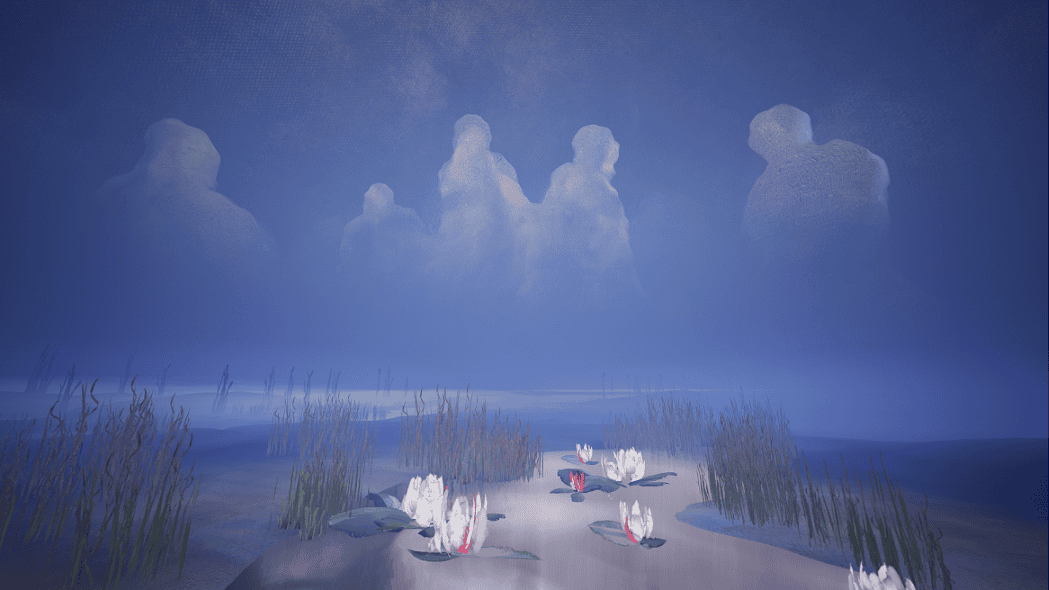
“Flowers were a great favourite in his life and could be seen every summer when he came to Druskininkai on holiday. Čiurlionis’ sisters tended a large, colourful flower garden right outside his studio window. Druskininkai holidaymakers often stopped to admire the Čiurlionis’ courtyard, and the sisters were often asked to sell flower plants. Behind their homestead on the outskirts of Druskininkai stretched the wild meadows in bloom, which probably inspired Čiurlionis to depict them in his painting “The Virgin” from the “Signs of the Zodiac” cycle. One of the most frequently used and easily recognisable is the water lily, which grew in the surrounding lakes,” says the museum director.
The world of symbols and the multi-layered nature of creation
According to the Director General of the M. K. Čiurlionis National Museum of Art, the abundance of floral motifs in Čiurlionis’s works is in line with the Art Nouveau trends of the early 20th century. At that time, flowers were an extremely popular element of aesthetic expression, dominating painting, fashion, architecture and furniture design. Čiurlionis, as a sensitive artist of his era, wove this aesthetic into his personal visual vocabulary, in which flowers are incorporated into the ornamentation, symbol system and spiritual atmosphere of his works.
“Čiurlionis’ work also repeats other symbols. Alongside flowers, images such as the cypress, the skull and the candle are important – they are typical of Symbolism. The serpent is a sign of life and wisdom, derived from Lithuanian mythology. The triangle is a symbol of world order and the Sun is a sign of life and prosperity. One of the most recurrent symbols is the ship, which takes on different meanings, from vulnerability to the passage to another plane of existence,” says Kamarauskienė.
According to her, when talking about Čiurlionis, we cannot separate his work from its context – he was shaped by the nature of Dzūkija, the personalities he met, the books he read, and the atmosphere of cities. However, the artist’s work is not one-dimensional. “There is no right or wrong way of reading – each work is multivocal, open to individual gaze, experience and inner resonance.”
Which paintings should I look for floral motifs in?
According to the museum’s director, floral motifs appear subtly in Čiurlionis’s works, but in some paintings they become a distinct compositional or emotional accent. One of the most expressive examples, she says, is Evening (1907), in which floating water lilies create a mood of transparent calm and concentration. In the triptych “Summer”, created in the same year, the atmosphere of a hot summer is conveyed by lush pilasters. In the later “Angels” (1909), the flowers of flowering meadows – dandelions and daisies – are transformed into a kind of paradise meadow, filled with joy and light.
However, as D. Kamarauskienė points out, the flowers depicted by Čiurlionis are not always recognisable or realistic. In his works Fantasia (1907-1908) and Creation of the Worlds (1905-1906), they become elaborate ornaments from dreams or cosmic visions, merging with other symbols and forms.
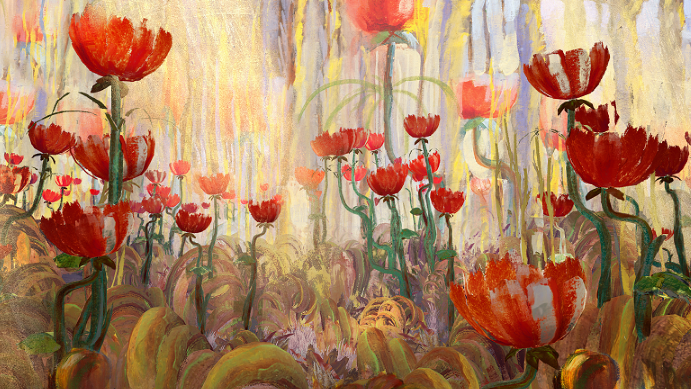
The ninth of the 13 paintings in the series, Creation of the Worlds, stands out from the rest with its warm, rich colours. It is an apotheosis of vegetation, symbolised by the unusually bright colour of flowers. Red is the colour of life and passion, which captures the viewer’s attention and suggests a vigorous burst of vegetation. Poppy flowers, illuminated by golden rays, boldly and with great vigour emerge from the cold ice blocks, from the clods of fertilised soil,” says Kamarauskienė.
Today, Čiurlionis’ works are also coming to life in contemporary forms – one of the most striking examples is the virtual reality experience “Creation of the Worlds”, created by Kristina Buožytė and Vitalius Žukas. In it, the viewer is invited to immerse into the artist’s dreamlike, symbol-laden world, where floral motifs occupy a special place – visually unfolding, breathing, accompanying through different worlds. This reminds us that even the most subtle signs of the artist’s work do not lose their relevance – they continue to live on in contemporary visual language and in man’s emotional relationship with art.
D. Kamarauskienė shares her impressions after the screening of ‘Creation of the Worlds’: