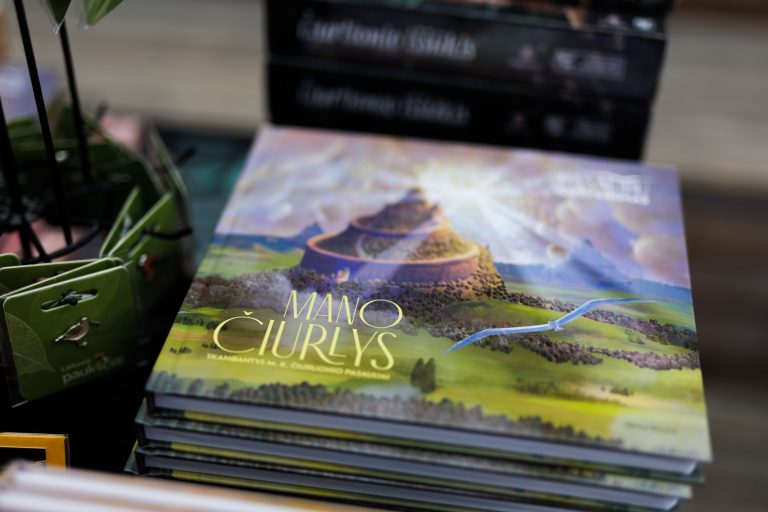
Book cover clipping
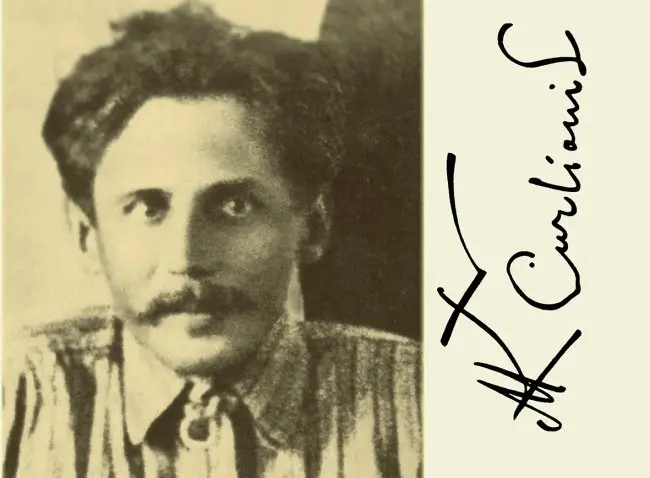
The most outstanding and the most unique – this is how anyone who has had the chance to touch his work out of the corner of their eye would describe the most famous Lithuanian painter and composer , M. K. Čiurlionis .
Viewers of the VR film “On the Trail of Angels” share that the integration of paintings and music into virtual reality technology is breathtaking. Others often say that it is a must-have experience for everyone at the age of 21, as this way of streaming art appeals to the younger generation, but is also extremely interesting for older people.
Kristina Buožytė, the director of the film “Trail of Angels” , says that the idea to integrate Čiurlionis’ paintings into the virtual space was born from seeing the tributes paid to foreign artists, so let’s get acquainted with Čiurlionis through the most colourful stages of his life.
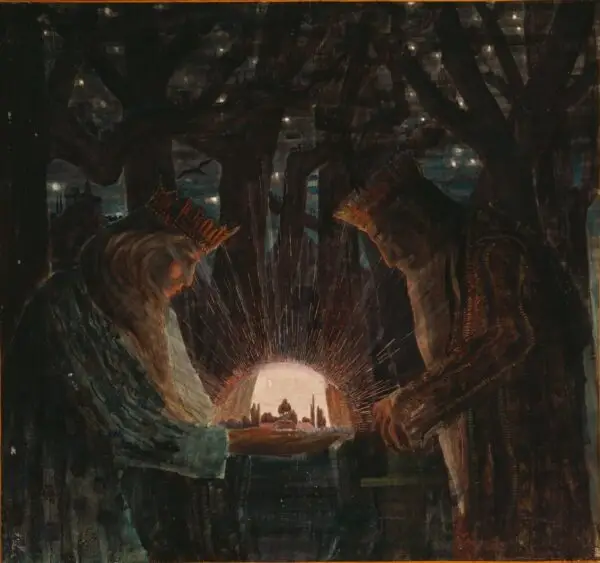
Painting “The Tale of the Kings” by M. K. Čiurlionis Canvas, tempera. 1909. 70,2cm × 75,3cm
The artist, who lived at the turn of the 19th and 20th centuries, was born in 1875 in what is now Stara Varėna, where he grew up in a family of nine children.
Čiurlionis’s first acquaintance with music was due to the influence of his father Konstantinas Čiurlionis, who was an organist and choirmaster, and so the future composer learned to play the piano at an early age.
In addition to the instrument, Čiurlionis’ childhood was also surrounded by live music, as his father’s mixed choir rehearsals were organised at the Čiurlionis’ home.
Interestingly, M. K. Čiurlionis was never able to speak and write Lithuanian correctly, and his family communicated in Polish.
Although he was born in Varėno, the future artist spent his childhood in Druskininkai due to his parents’ change of residence. In 1885, he graduated from a folk school and, as it is said, was extremely eager to learn.
In 1889 Čiurlionis came to Plungė, where he played in the orchestra of the court of the patron of culture, Duke Michael Oginski. His first steps as a composer were made here, when his first small-scale works were born.
The path of discovery
In 1894, after receiving funding from Prince Mykolas Kleopas Oginski, he went to the Warsaw Music Institute to study piano and composition. Čiurlionis studied in Warsaw for five years.
After completing his studies, in 1899, the composer was offered the position of director of a music school in Lublin, but declined the offer because he wanted to deepen his musical knowledge.
After another 3 years of living in Warsaw, where he worked as a teacher in private music lessons, Prince Oginski again offered funding for his studies, and from 1901 onwards Čiurlionis continued his studies at the Royal Conservatory in Leipzig, where he focused on composition and counterpoint.
Then began the consistent creative process of M. K. Čiurlionis. In Leipzig, he began to compose his first neo-romantic musical works. Leipzig, as the cultural centre of Germany, allowed the composer to see and discover operas, museums, and philosophical writings, and his life in Saxony is marked as a time of comprehensive development in the composer’s history.
During his studies at the Royal Conservatory in Leipzig, Čiurlionis composed his first famous musical work, the symphonic poem “In the Woods”, which combines the nostalgia of his homeland with the melodic structures of Romantic music.
It is said that at that time M. K. Čiurlionis blossomed as a creator, purified his worldview and acquired his own style.
The era of art
While living and studying in Leipzig, Čiurlionis became acquainted with the Symbolist works of the Swiss A. Böcklin and the German M. Klinger. At that time, the composer became interested in art.
After studying at the Royal Conservatory in Leipzig in 1902, Čiurlionis returned to Druskininkai, where he did not stay long.
In the same year, the composer went to Warsaw to study art professionally, but it wasn’t long before he realised that an academic programme in painting was unacceptable to him.
Although he studied art academically, Čiurlionis remained devoted to his own style and was distinctive, inclined towards symbolism.
Čiurlionis was fascinated by philosophical insights and visual abstractions. He also interpreted musical works and sounds in his paintings, which is why the experience of the virtual reality film “On the Paths of Angels” is so unique – the paintings reflect the symphonies that can be heard, the sound seems to merge with the image.
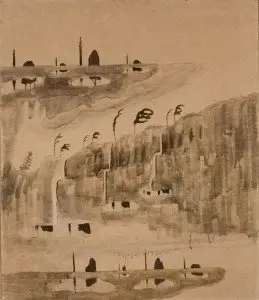
SONATA II (Spring Sonata). Paper, tempera. 1907, Druskininkai. 72,8cm × 62,8cm.
The artist’s work is imbued with a philosophy of the fragility of life, death, eternity and extinction, influenced by life in Leipzig.
Returning to his homeland in 1905, Čiurlionis wrote bitterly that he was misunderstood by strangers and relatives alike. People in Lithuania at that time did not understand the artist’s works, and Čiurlionis himself was viewed with suspicion and unfavourably.
In 1903-1907, M. K. Čiurlionis composed one of his most famous musical works, the symphonic poem “The Sea”, but he felt more and more inclined towards art.
In 1906, Čiurlionis’s paintings were exhibited in St. Petersburg, which attracted the attention of Russian cultural society.
1907 was the year when the artist finally left the world of music and immersed himself in art. From this year onwards, Čiurlionis’s evolution as an artist was marked by the creation of complex, advanced series of paintings.
Interestingly, the paintings by M. K. Čiurlionis are almost independent of their historical context. Biblical and Christian motifs are intertwined with a pantheistic worldview in his paintings.
However, there are some works that recall the significance of national self-understanding (“City. Prelude”) using folk art motifs.
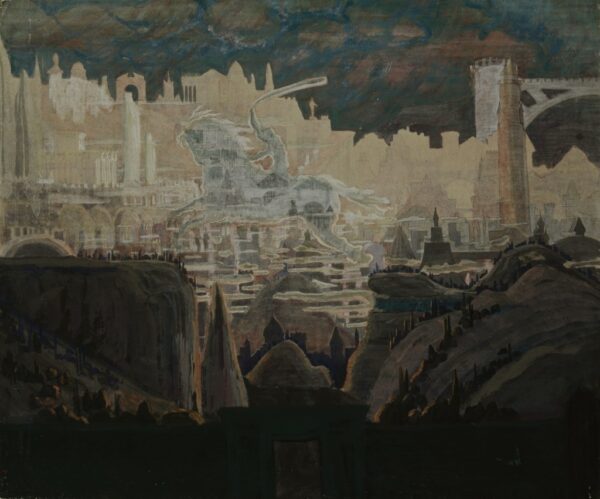
M. K. Čiurlionis. City. Prelude. 1908-1909. Paper, tempera. 59,0×70,4
Cultural activities
M. K. Čiurlionis was active in cultural activities. During the 1905 National Uprising, the artist took care of the preparation of the First Lithuanian Art Exhibition at the Vilnius Vileišiai Palace, shared his paintings, and contributed to the establishment of the Lithuanian Art Society.
It is symbolic that during the first exhibition of Lithuanian art, Sofija Kymantaitė, the future wife of M. K. Čiurlionis, saw the artist for the first time from afar.
The future lovers met for the second time two years later, in 1907, during the Vincas Kudirka celebrations. The meeting was fateful.
In 1908, Čiurlionis organised the Second Exhibition of Lithuanian Art and established a music fund to support the work of local composers. The Foundation was active from 1908-1911.
On 1 January 1909, M. K. Čiurlionis married the writer Sofija Kymantaitė at the St. Mark the Evangelist church in Šateikiai.
In the same year, Čiurlionis went to St Petersburg with great ambitions, but he soon realised that talent alone was not enough – in the cultural capital of Russia, you always have to be on a pedestal, or else nobody will pay attention to you.
Shortly afterwards, with the help of the artist Mstislav Dobužinski, the doors of the home of the famous and influential artist Alexander Benua were opened to the talented artist, and the music of Čiurlionis began to be heard in prestigious concert halls.
It soon became clear that distributing creative energy was more difficult for Čiurlionis than had been thought. Other artists complained that Čiurlioni was devoting too much time to music, and that he was trying too hard to translate the principles of musical composition into painting.
At the time, poverty and stress caused serious health problems. Due to lack of money, Čiurlionis painted many of his paintings on plain paper.
Although the sensitive artist went through a difficult emotional period, it was during this period that he created some of his most famous and significant paintings: the Serpent, the Sea, the Star Sonatas, the Tale of the Kings, and the monumental masterpiece Rex, all of which were published at the Third Lithuanian Art Exhibition in 1909.
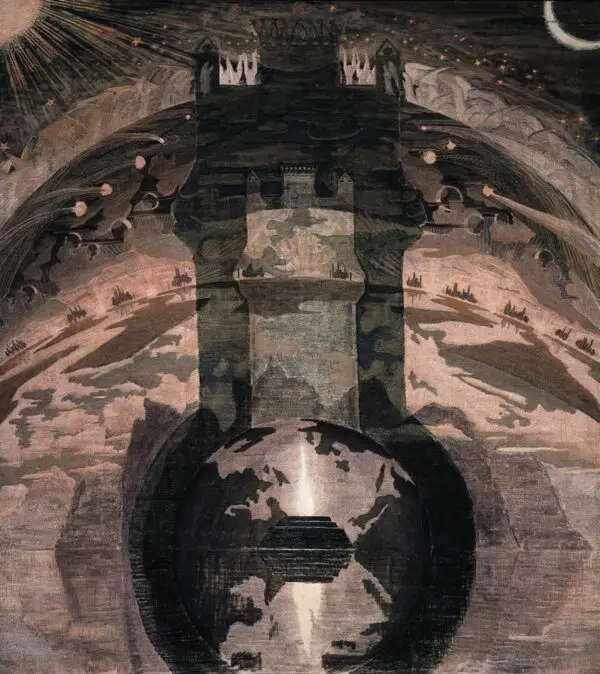
REX. Canvas, tempera. 1909. 147,1cm × 133,7cm
Last years of life
The last years of his career were extremely difficult for Čiurlionis, both spiritually and psychologically.
At the end of 1909, the artist was diagnosed with psychological and emotional overwork.
In the same year, the artist travelled to St Petersburg, where he suffered a nervous attack and ended up in the Pustelnik Red Manor Sanatorium in Poland, famous for its humane treatment of mental illness.
12 June 1910. The Čiurlionis had a daughter, Danutė, whom the overworked artist never saw.
When his mental health seemed to be recovering, Čiurlionis fell ill with pneumonia during a walk in a sanatorium and died shortly afterwards in 1911 at the age of 35.
Čiurlionis’ remains were brought from Pustelniko to Vilnius. The composer and painter was laid to rest in the Rasai Cemetery in Vilnius.
You can learn more about M. K. Čiurlionis’ work here: https://ciurlionis.eu/lt/